Food
Typical dishesAutumn and winter are the “main” seasons of the Asti and Piedmontese cuisine.• Raw beef with truffle (trìfula), veal with tuna sauce, peppers in bagna cauda, veal tongue in green sauce (bagnet verd), “electric” tomini (cheese with chilli pepper), rabbit tuna, are just a few of the typical Asti appetizers.• Donkey Agnolotti, hare agnolotti; egg tagliatelle (tajarin) with roast sauce, truffle or porcini mushrooms, for the first courses.• Boiled fatty beef with “tanning” polenta (seasoned with stringy cheese).• the financier: the name of this recipe derives from the suit, called just “financier”, usually worn in 1800 by bankers and high finance men, who seem to like this dish very much; other sources suggest instead the origin of the name in the tribute in kind paid by the farmers to the guards (the financiers, in fact) to enter the city. Tribute mainly composed of the offal of chickens, still today among the fundamental ingredients.• Piedmontese mixed fry (fricia) linked to the pig slaughtering ritual and the need not to waste anything. It included innards, black puddings, lung (fricassà bianca), liver (fricassà nèira), sweetbreads. Over time, it has been enriched with new ingredients and there are numerous versions: pumpkin flowers and amaretti are typical of Monferrato.• roast veal and braised beef with barbera or barolo.
Desserts• Polentina from Asti, made with almonds, raisins, maraschino and covered with yellow polenta.• Amaretti from Mombaruzzo or Canelli, soft almond biscuits.• The hazelnut cake.• The zabaglione with Barbera or Muscat.• The ancient mon (pronounced “mun”) of Mongardino (soft brick).• The peaches at the Ruché di Castagnole Monferrato.
Cheeses• Robiola di Roccaverano, fresh DOP cheese, prepared with cow’s milk, sheep’s milk, goat’s milk.• Robiola di Cocconato, fresh cow’s milk cheese (it was once made with raw milk).• Piedmontese Toma, cow’s milk cheese, whose history dates back to the 14th century.
Points of Interest
Complex of San Pietro
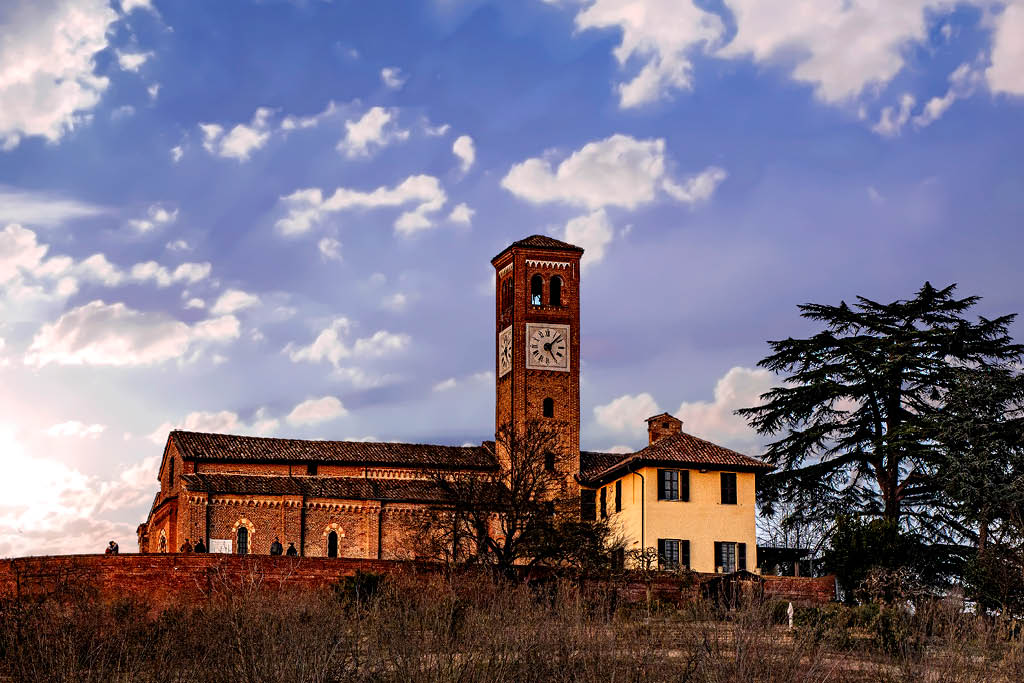
Extraordinary for the beauty and the documentary value of the architecture and decorations, it is made up of the 12th century Church (Rotonda) of the Holy Sepulcher, the convent-hospice of the knights of St. John of Jerusalem whose marvelous cloisters and chapel are visible of the XVth century. The Civic Archaeological Museum is located here, the result of private donations to the Municipality of Asti.
Civic building – Palazzo civico
The palace, seat of the Municipality, donated to the city in 1558 by Duke Emanuele Filiberto di Savoia, was built in the mid-thirteenth century and was then profoundly modified in the fifteenth century. Transformed into the baroque forms visible today between 1726 and 1730 on a project by Benedetto Alfieri, it underwent further subsequent alterations. In 1817 the facade was completed with the construction of the viewpoint and in 1867 the north sleeve was built.The decoration of the staircase, 1935, is the work of the Asti painter Ottavio Baussano.
Palazzo Mazzetti di Frinco
The building testifies to the affirmation of the Mazzetti family within the Asti aristocracy. The building was enlarged from the end of the seventeenth century, when the Mazzetti bought and joined the adjacent medieval buildings, then proceeding with their reshaping in a single noble palace.Since 2000 Palazzo Mazzetti has been owned by the Cassa di Risparmio di Asti Foundation, which oversaw its restoration. It is now the headquarters of the Asti Museums Foundation and hosts temporary exhibitions of international importance. It holds and displays the civic collections consisting of paintings, sculptures and objects of remarkable artistic quality.
Ottolenghi Palace – Palazzo Ottolenghi
The building took on its current appearance after 1754 on the initiative of Count Carlo Gabuti di Bestagno, who, probably, entrusted to Benedetto Alfieri, the task of modernizing the existing medieval buildings in a single and more modern building. The palace was then purchased in 1851 by the Ottolenghi family and since 1932 it is owned by the municipality. It has rich furnishings and rich is also the pictorial decoration. In 2016 the restoration of the atrium, the grand staircase and the reception hall was completed.It houses the “Garibaldi” Museum of the Risorgimento and Partisan Division, the Historical Institute for the Resistance and the Museum of the Imaginary.
Crypt and Museum of Sant’Anastasio
Located in the so-called Palazzo del Collegio, the museum allows you to retrace the city’s two-thousand-year history through a rich stratification of archaeological remains. The crypt of Sant’Anastasio is the oldest nucleus, dating back to the 11th century, it has recovered columns and capitals from the Roman and early Middle Ages. In the spaces adjacent to the crypt there are visible traces of pavement of the Roman forum of Asti, tombs dating from the seventh and tenth centuries, remains of the early medieval church, of the Romanesque church and of the seventeenth-century church of Sant’Anastasio, demolished in 1907. The stone collections of Asti are exposed here: capitals, corbels, sculpted tiles, cantonal stones dating from the XII and XVI centuries.
Palazzo Alfieri
Birthplace of the poet Vittorio Alfieri. The building is the result of the renovation of previous medieval buildings, built around 1738 on a probable project by Benedetto Alfieri, the poet’s cousin. In 1901 the building was purchased by Count Leonetto Ottolenghi, a prominent member of the Asti Jewish community, who then donated it to the Municipality. It is currently the headquarters of the Eugenio Guglielminetti Foundation which collects unique testimonies of the activity of the Asti painter and scenographer Eugenio Guglielminetti and preserves its art collections, of the National Center of Alfierian Studies Foundation which studies the figure and work of Vittorio Alfieri, of the Alfieriano museum and of the modern and multipurpose museum educational center of the Asti Musei Foundation.
Palazzo del CollegioIt is a complex of buildings in the heart of the historic center. The buildings form a quadrilateral (with a main view of C.so Alfieri) which delimits the large block formerly known as Sant’Anastasio. For centuries, the area was in fact occupied by the homonymous Benedictine monastery, documented from 1008, but perhaps already existing at the end of the ninth century, if not actually of Lombard foundation (VIII century).Completely transformed after the demolition, in 1907, of the seventeenth-century church of Sant’Anastasio, today it houses, in addition to some schools, the “Giorgio Faletti” Library Foundation of Asti named after the actor and writer from Asti who died prematurely in 2014. The Astense library organizes the Passepartout literary festival every year in early June.
Torre Comentina
Also known as the “tower of San Bernardino”, it is located on the west corner between Piazza Roma and Corso Alfieri and is now incorporated into the structure of the twentieth-century neo-Gothic castle that overlooks the square. With its 38.55 m. it is, by height, the second tower in the city. It has a square plan and ends with a terrace with Ghibelline dovetail battlements and an underlying decoration with a double order of terracotta and sandstone arches. The pointed windows open on all four sides and are decorated in the last order with the same color pattern as the arches above. For the type of structure and decoration, the tower is dated to the second half of the thirteenth century.
Torre De Regibus.
Located on the corner of via Roero and corso Alfieri, it is the only example of an octagonal tower that survived Asti. It was part of a complex of buildings owned by the De Regibus family that also counted two other towers. These three towers were known by the name of “Three Kings”, which still remains today to indicate the block. It features a series of single lancet windows decorated in terracotta and stone. Its construction is to be traced back to the end of the thirteenth century, it was originally high probably around 39 meters, today, after the severing which had to affect the three upper floors, it measures about 27 meters.
Torre Rossa or San Secondo
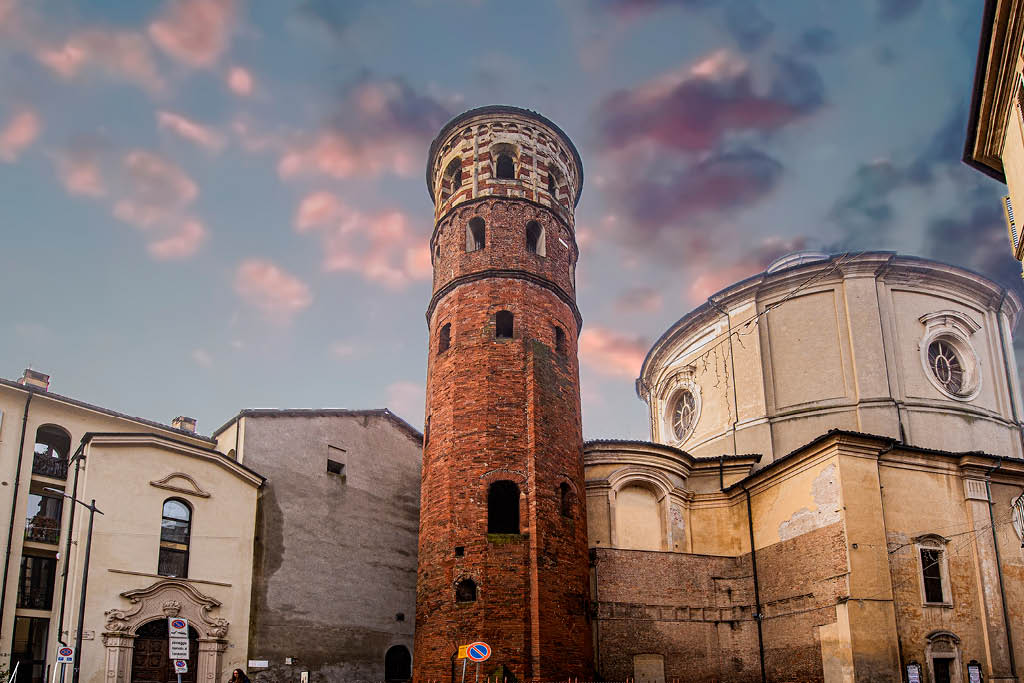
In bricks and sandstone. With a polygonal base (16 sides), it is the surviving part of the western Roman gate. Dating from the 1st century AD, in the 11th century it was raised two floors and used as a bell tower at first for the Romanesque church of San Secondo (precisely called “della Torre Rossa” to distinguish it from the patronal or collegiate church) and from 1766 for the parish church of S. Caterina.The Romanesque addition has the lower brick floor and is marked by simple round single lancet windows that open on alternate sides. Under the second string course there is a row of terracotta hanging arches. The upper floor is more elaborate, where sandstone blocks alternate with short brick inserts. The single-lancet windows are divided by cubic capitals. The decoration ends with a last row of hanging sandstone arches. It is the tower, where, according to tradition, San Secondo, patron of Asti, was imprisoned. Palazzo del MichelerioThe complex, former monastery of Gesù delle Clarisse Osservanti dates back to the 16th century. It was enlarged in the second half of the eighteenth century, without altering its sixteenth-century layout. During the Napoleonic period the complex was expropriated and became public property. Put up for auction, in 1870 it became the seat of the Opera Pia Michelerio, which dealt with welcoming and educating the orphans of Asti and its surroundings. Today it houses private offices and is home to the Paleontological Museum which, through the general concepts of paleontology, illustrates the main geo-paleontological events that led to the formation of the Asti area. There are exposed some fossils recently found in the area among which the bone remains of whales and dolphins of the Pliocene age stand out, from about 5 to 2 million years ago.The Asti area has rich deposits of paleontological fossils. First of all, those of the Special Paleontological Nature Reserve of Valle Andona, Valle Botto and Val Grande, an area 7 kilometers west of Asti.
Palazzo Mazzola
The palace presents itself to the visitor in its predominant Renaissance facies which dominates, but never completely covers, the different souls that make up its extraordinary architecture. The medieval domus, built on a site of Roman settlement, first, and later Lombard, was in fact acquired by the lords Mazzola and transformed by them in the Renaissance sense around 1516.The Palace became, starting from 1710, by donation of Giacomo Filippo Mazzola the “home” of the Opera Pia Buon Pastore, destined to house “perilous and dangerous youngsters and abandoned infants”.During the eighteenth century, the building underwent profound changes which also followed in the following years.Today, Palazzo Mazzola houses the Municipal Historical Archive and the Palio di Asti Museum.The Historical Archive preserves all the documentation of the Municipality of Asti in its activity through the centuries. The documents, which can be consulted by the public, range from the 10th to the beginning of the 21st century: among them, the precious medieval manuscript codes decorated with extraordinary miniatures.The Palio Museum in Asti offers a route dedicated to the historic festival of the city which is also a journey through the city’s history, reconstructed in filigree through the story of its oldest and most prestigious event.
Synagogue and Jewish Museum
The Synagogue has been documented on the current site since 1601. Modified in 1788, enlarged in 1848-50, it took on its present appearance with the renovation of 1888-89. The museum preserves silver, textiles, objects of worship, furnishings, plaques, prayer books, photographs, manuscripts and offers an overall image of the various aspects of Jewish life and culture within the framework of the historical reality of the Jews of Asti, whose presence in City has been documented since the year 812.